
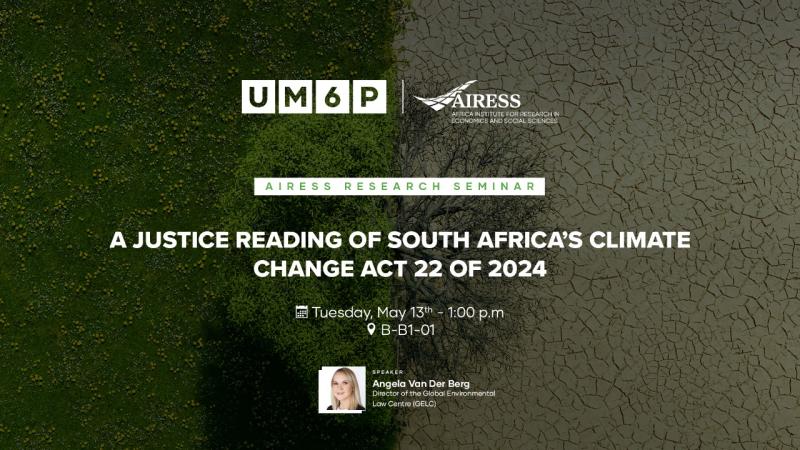
Angela Van Der Berg, Director of the Global Environmental Law Centre, will lead the upcoming AIRESS Research Seminar on Tuesday, May 13th, starting at 1 p.m. She will explore the Climate Change Act through the lens of climate justice, focusing on how the legislation addresses the unequal burden of climate impacts on marginalized communities.
ABSTRACT
South Africa, a nation profoundly vulnerable to the impacts of climate change, stands at a critical juncture with the enactment of the Climate Change Act 22 of 2024. This legislation arrives in the midst of escalating environmental challenges—rising temperatures, erratic rainfall, and increasingly severe droughts—aggravating the socio-economic inequalities deeply entrenched in the fabric of the nation. While the Act marks a significant step toward formalizing the country's commitment to mitigating climate change, it also raises pressing questions about climate justice, particularly in the context of South Africa's historical and ongoing socio-economic inequities.
This paper offers a critical analysis of the Climate Change Act through the lens of climate justice, focusing on how the legislation addresses—or fails to address—the disproportionate burden of climate impacts on marginalized communities. By examining the Act's provisions on mitigation, adaptation, and the allocation of resources, this paper interrogates whether the law adequately reflects the pillars of climate justice, notably, procedural justice, recognition justice, distributional justice and intergenerational justice. The analysis considers the Act's potential to either perpetuate existing injustices or catalyze meaningful change by empowering vulnerable populations, ensuring equitable access to resources, and fostering resilience across diverse communities.
Ultimately, this paper argues that while the Climate Change Act 22 of 2024 represents a legislative milestone, its success in advancing climate justice will depend on its implementation and the extent to which it prioritizes the needs and voices of those most affected by climate change. In the context of South Africa's complex socio-political landscape, this Act must be critically assessed not only as a legal framework for environmental and climate governance but also as a tool for rectifying the deep-seated inequities exacerbated by climate change. This analysis offers insights for other African nations now in the process of drafting their own climate legislation, underscoring that climate laws across the continent must confront socio-political complexities and prioritize justice-centered approaches to address Africa's distinct vulnerabilities and foster resilient futures for all.